‘Assam is boiling’

Human rights defenders struggling to support millions left in immigration limbo by India’s National Register of Citizens

Tanya Singh & Haseena Manek

It has been two months since India threw nearly four million people into a desperate scramble to prove their citizenship or risk deportation. The government published a draft of the National Register of Citizens in late July and the effects were immediate: millions excluded from the list were made to produce evidence of their legitimate claims, security forces were put on alert to quell potential violence in a region with a history of persecuting ethnic minorities, and at least one thousand people are still being held in criminal jails serving as immigration detention centres.

Read the full blog post on Front Line Defenders website.

Hotel workers from around the world challenge sexual harassment

Hotel workers facing sexual harassment from guests hand list of demands to Marriott bosses at UN Labour Council meeting in Geneva.

During the United Nations International Labour Organization Conference in Geneva last month, hotel workers from across the globe met to discuss the issue of sexual harassment in the workplace and hand an accord addressing the issue to Marriott bosses

Read the full story at Rank and File.

Homeless in the “Happiest Country in the World”

How people fall through the cracks in the Danish welfare system.

Like other Nordic countries, Denmark is known globally for its comprehensive social services and a high ranking on the World Happiness Index. It may then come as a surprise that like other urban centres internationally, homelessness is an issue for Denmark’s big cities.

For example, if you are an unemployed citizen of Denmark, you are eligible to receive up to 90% of the income you made at your last job. Compare this to Canada, for example, where unemployment benefits start at 55% of your previous income with a cap at $49,500 CAD per year (approximately 250,500 DKK or 33,500 EUR). Despite this, homelessness remains an issue in larger cities like Copenhagen and Aarhus.

Read the full editorial on the Jutland Station website.

Muslim Feminisms: Solidarity Before Censure

There are many ways to be a feminist. There are many ways to show solidarity. It should go without saying that there are many ways to practice Islam.

In light of the recent terrorist attacks in Paris and the subsequent spate of abuse and assaults against Muslims living in Western countries, it is important that the vulnerability of visibly Muslim women is acknowledged. Even non-Muslim women of colour are at risk for abuse, should they choose to protect themselves from the cold with a vaguely Islamic scarf. As non-veiled Muslim women, both myself and Yasmin Alibhai-Brown carry a certain privilege in our ability to pass through Islamophobic spaces with slightly less scrutiny than our hijabi sisters.

Inclusive feminism necessitates an acknowledgement and acceptance of both the vulnerability of visibly Muslim women and the privilege of non-visibly Muslim women. Muslim women, veiled and unveiled, need to stand together. Feminists, Muslim or not, need to stand together. Without this, we are only perpetuating transcultural patriarchy—which seeks control of women’s bodies—through simultaneous criticism of wearing too much and too little.

Alibhai-Brown’s new book Refusing the Veil is at points a thoughtful and comprehensive walk through important points in the history of Islam and philosophies of practice. At other points, however, it reads as a soft conservative polemic against Muslim women and their agency, fraught with contradictions about how women should walk the fine balance between modest and slutty.

Read the full review at GUTS Magazine.

Moderate Islam and Palestine solidarity: A response to Aliya Manjee

April 13, 2015

As I read through Aliya Manjee’s editorial ‘I’m Muslim, Pro-Palestine and Visited Israel’, I couldn’t help but feel that despite first-hand experience, her comments about Israel and Palestine were remarkably reductive.

Manjee is candid about her political position (identifying as Pro-Palestine as early as the headline) and her personal identity (Shia-Ismaili-Muslim). She writes that being the only Muslim on her trip set her apart from her peers and that she does not think her identity — specifically her faith — should dictate her views on Israel and Palestine.

Read the full Op-Ed on the rabble.ca website.

Toronto activists intensify campaign against SodaStream

On Sunday, August 31st, the Coalition Against Israeli Apartheid (CAIA) gathered to share information with members of the Toronto community about the current campaign to boycott SodaStream, a carbonated beverage company whose main production facility is in Ma’ale Adumim, an illegal Israeli settlement in the occupied Palestinian West Bank.

As part of the international campaign to Boycott SodaStream, CAIA launched a its own campaign in October of 2013 asking homewares company Bed Bath and Beyond to stop carrying SodaStream products.

Read the full article on Mondoweiss.

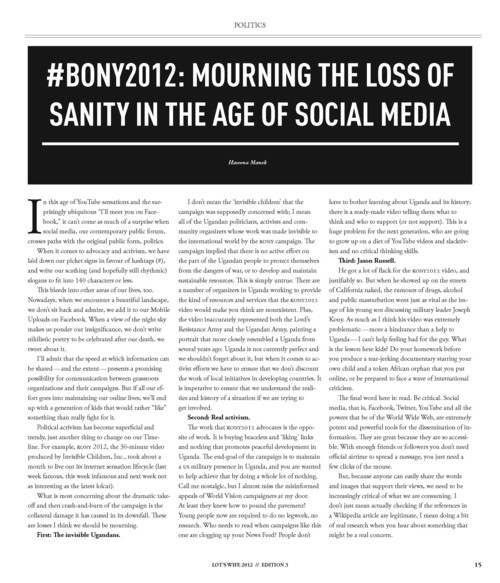
#BONY2012: MOURNING THE LOSS OF SANITY IN THE AGE OF SOCIAL MEDIA

In this age of YouTube sensations and the surprisingly ubiquitous “I’ll meet you on Facebook,” it can’t come as much of a surprise when social media, our contemporary public forum, crosses paths with the original public form, politics.

When it comes to advocacy and activism, we have laid down our picket signs in favour of hashtags (#), and write our scathing (and hopefully still rhythmic) slogans to fit into 140 characters or less.

This bleeds into other areas of our lives, too. Nowadays, when we encounter a beautiful landscape, we don’t sit back and admire, we add it to our Mobile Uploads on Facebook. When a view of the night sky makes us ponder our insignificance, we don’t write nihilistic poetry to be celebrated after our death, we tweet about it.

I’ll admit that the speed at which information can be shared — and the extent — presents a promising possibility for communication between grassroots organizations and their campaigns. But if all our effort goes into maintaining our online lives, we’ll end up with a generation of kids that would rather “like” something than really fight for it.

Political activism has become superficial and trendy, just another thing to change on our Timeline. For example, Kony 2012, the 30-minute video produced by Invisible Children, Inc., took about a month to live out its internet sensation lifecycle (last week famous, this week infamous and next week not as interesting as the latest lolcat).

What is most concerning about the dramatic take- off and then crash-and-burn of the campaign is the collateral damage it has caused in its downfall. These are losses I think we should be mourning.

First: The invisible Ugandans.

I don’t mean the ‘invisible children’ that the campaign was supposedly concerned with; I mean all of the Ugandan politicians, activists and community organizers whose work was made invisible to the international world by the Kony campaign. The campaign implied that there is no active effort on the part of the Ugandan people to protect themselves from the dangers of war, or to develop and maintain sustainable resources. This is simply untrue. There are a number of organizers in Uganda working to provide the kind of resources and services that the Kony 2012 video would make you think are nonexistent. Plus, the video inaccurately represented both the Lord’s Resistance Army and the Ugandan Army, painting a portrait that more closely resembled a Uganda from several years ago. Uganda is not currently perfect and we shouldn’t forget about it, but when it comes to activist efforts we have to ensure that we don’t discount the work of local initiatives in developing countries. It is imperative to ensure that we understand the realities and history of a situation if we are trying to get involved.

Second: Real activism.

The work that Kony 2012 advocates is the opposite of work. It is buying bracelets and ‘liking’ links and nothing that promotes peaceful development in Uganda. The end-goal of the campaign is to maintain a US military presence in Uganda, and you are wanted to help achieve that by doing a whole lot of nothing. Call me nostalgic, but I almost miss the misinformed appeals of World Vision campaigners at my door. At least they knew how to pound the pavement!

Young people now are required to do no legwork, no research. Who needs to read when campaigns like this one are clogging up your News Feed? People don’t have to bother learning about Uganda and its history; there is a ready-made video telling them what to think and who to support (or not support). This is a huge problem for the next generation, who are going to grow up on a diet of YouTube videos and slacktivism and no critical thinking skills.

Third: Jason Russell.

He got a lot of flack for the Kony 2012 video, and justifiably so. But when he showed up on the streets of California naked, the rumours of drugs, alcohol and public masturbation went just as viral as the image of his young son discussing military leader Joseph Kony. As much as I think his video was extremely problematic — more a hindrance than a help to Uganda — I can’t help feeling bad for the guy. What is the lesson here kids? Do your homework before you produce a tear-jerking documentary starring your own child and a token African orphan that you put online, or be prepared to face a wave of international criticism.

The final word here is: read. Be critical. Social media, that is, Facebook, Twitter, YouTube and all the powers that be of the World Wide Web, are extremely potent and powerful tools for the dissemination of information. They are great because they are so accessible. With enough friends or followers you don’t need official airtime to spread a message, you just need a few clicks of a mouse.

But, because anyone can easily share the words and images that support their views, we need to be increasingly critical of what we are consuming. I don’t just mean actually checking if the references in a Wikipedia article are legitimate, I mean doing a bit of real research when you hear about something that might be a real concern.

as published in Lot’s Wife, 2012

 tumblr_m9g5qpUifh1qb71ed

tumblr_m9g5roRkc41qb71ed

Nakba Day in Palestine: A time to remember and resist

May 15, 2012

May 15 marks the anniversary of the “Nakba” (Arabic for “catastrophe”), the dispossession of the Palestinian people that came with the creation of the state of Israel in 1948.

This year is the 64th anniversary. The day is acknowledged with protests throughout the Middle East. Last year, in Egypt, hundreds of protestors were arrested or injured, while a number of poeple were killed by Israeli forces when protesters marched on the borders of Israel and the occupied Palestinian territories, including at the Lebanese and Syrian borders.

May 15, 1948 is known as the Nakba because hundreds of thousands of Palestinian people were forced from their homes, or chose to leave to protect themselves and their families from violence. Some Palestinian people still carry the keys to the houses they had to leave, which are now being lived in by Israelis. This has made the image of a key an important symbol for protesting Palestinians.

But what does it mean, 64 years later, to have a Nakba Day?

Read the full article on rabble.ca.

Will Canada ever leave Afghanistan? Harper extends mission for another three years

December 2010

Will Canada ever leave Afghanistan? This is a difficult question. I believe the answer is yes.

When attempting to answer this question, there are three things we must consider. First, Canada’s relationship to the United States; second, the reasons given for the military occupation of Afghanistan; and third, public opinion.

Canadian involvement in Afghanistan started in 2001, with a small contingent aiding the U.S.-led invasion, increasing slowly until today, where we have almost 3,000 troops, largely based in and around Kandahar, Afghanistan’s second largest city.

While it was Jean Chrétien’s Liberal government that initially gave support to U.S. opera- tions in Afghanistan with about a hundred Canadian troops, it has been Harper’s Conservative government that has increased support of the American initiative, continuing to extend the Canadian military presence in Afghanistan.

Despite Obama’s campaign promises to decrease the American military presence in Afghanistan, it looks as if the troops won’t be coming home anytime soon.

In Canada, as the previously announced term for the combat mission ends (mid-2011), the Harper government has managed to extend, once again, the mission by another three years.

While the majority of troops are to return to Canadian soil (or to another mission the government has yet to announce), about 950 troops will remain in a “training” capacity.

The newly extended, now so-called humanitarian mission, will have four main goals, at least according to the Canadian government: “investing in the future of Afghan children and youth through development programming in education and health; advancing security, the rule of law and human rights, including through the provision of up to 950 trainers for Afghan security forces; promoting regional diplomacy; and helping deliver humanitarian assistance.” The government elaborates its goals on a website called “Canada’s Engagement in Afghanistan.”

Now that our mission no longer appears to be a combat initiative, I believe it is less likely that the general public will find reasons to be opposed to Canadian military presence in Af- ghanistan.

Humanitarian missions and development initiatives are currently so popular with liber- als-wanting-to-be-leftist/Free-the-Children-but-go-fair trade/hippie/hipster youth culture that converting the mission mandate from war to development was probably the most clever PR move yet.

By playing up the “bring our troops home (preferably not in body bags)” angle, those op- posed to foreign occupation garnered much support. However, if people start to think that the newly extended post-2011 mission is a friendly and safe expedition, then it may become hard to convince them otherwise.

On the other hand, it appears the Canadian public is hardened by a decade of the “War on Terror.” A recent Canadian Press/Harris-Decima poll shows that the majority of Canadians are opposed to a continued military presence in Afghanistan, and will only tolerate the extended humanitarian mission if it there is no combative engagement.

Of those that responded to the poll, 60 per cent were opposed to having Canadian troops in Afghanistan. The poll also brings to light another reason why public opinion – and making our voices heard to the powers that be – is so important.

From this poll, we can see that once again the Harper government (this time supported by Liberal leader Michael Ignatieff ) is “paddling against the tide of public opinion.”

“It’s a rare instance…” says Harris-Decima chairman Allan Gregg, “where the two major parties have come together, knowing that they’re probably on the wrong side of public opinion, to do what they believe in their heart of hearts is the right thing.”

My question is this: how much longer can our government make excuses for a mission so obviously opposed by the majority of Canadians? While this would not be the first time public opinion is ignored for the sake of war and political power, we have to believe that our elected government will only be able to oppose us so openly for so long.

At the very least, Harper only has two years left in his term, and let’s hope opposition to his global affairs strategies will translate into general opposition at the ballot box.

Most Afghans want troops to leave their country. Read about the poll here: bit.ly/gPYnPZ

as published in the Ryerson Free Press, December 2010

Islamophobia in the U.S.

October 2010

Islamophobia is not like a man who was stabbed on the street and whose wound is now healing. Islamophobia is a chronic and resilient disease, predating 9/11 and ingrained in Western society.

Cases like Reverend Terry Jones of Florida and his Qur’an burning madness are often treated like random cases of violent hatred, longstanding products of a ten-year-old tragedy.

But the 2001 attacks on New York City’s World Trade Centre, and the subsequent media circus surrounding pseudo- revenge plots and invasion of the Middle East did not create islamophobia in the United States. It has been a by-product of a litany of incidents in a lengthy political history of East/West relations.

The media frenzy surrounding Reverend Jones’ retaliation to controversy surrounding plans for an Islamic centre, (sup- posedly two blocks away from 9/11’s Ground Zero in New York) sensationalized the incident, making it appear like a random or unique example of a hate crime in America.

The goal here is not to understate the issue, or to imply that bargaining burned holy scripture in exchange for moving the Islamic centre is anything but abhorrent, but the question that needs to be asked is: Is this really something new?

Reverend Jones is obviously not the only American citizen plagued by intolerance. Close to this year’s anniversary of the at- tacks, the editor of a Maine newspaper had to issue a front-page apology for putting an image and accompanying story about the end of the holy month of Ramadan on September 11, 2010.

This came in response to local readers being ‘offended’ by the sight of peaceful Muslims, one Portland Press Herald reader wrote to the paper, “I don’t want to hear how caring the Muslim religion is on 9/11” (as reported by news.gather.com).

By continually overstating and re-examining these inci- dents, media is not necessarily exhibiting how rooted islamo- phobia and anti-Arab racism is in America, which is what it should be doing.

These examples should be used to reveal the depth and reach of islamophobia and anti-Arab racism, which in turn would be helpful in deconstructing the historical and contem- porary processes that foster this hatred.

Instead, Reverend Jones is a mascot for the supposed “randomness” or unsystemic nature of islamophobia, which only serves to gloss over the particular features of this painful and destructive phenomenon.

Additionally, media coverage is then forced to shift to the response to Reverend Jones’ crass pronouncement, which included a number of violent protests across the globe.

Quotes from General David Petra- eus, the U.S. and NATO commander Kabul, Afganistan, Robert Gates, the U.S. defence secretary, President Obama himself and even the Vatican peppered online media coverage on the incident.

They appropriately denounced the burning of the Holy Qur’an, but by this time, who can even remember that the Reverend Jones’ controversy was in response to another storm altogether?

American citizens had taken issue with the idea of an Islamic centre being built so close to Ground Zero, so close to the anniversary of the tragic incident.

The Associated Press quotes Editor Richard Connor of the Portland Press Herald as saying “the newspaper should have shown sensitivity ‘toward the painful memories stirred by the anniversary of 9/11.’”

What I would like to see discussed is why painful memories of this national crisis are so profoundly and acutely linked to Islam.

Why do the uncreative antics of a bigot get more headlines and more dis- cussion than the root issue itself? Let us revaluate how and why the very sight of American citizens practising their faith is immediately linked to the media-cultivated and propagandic enemy of the American people.

Terry Jones is a dime a dozen, and will remain so as long as the Western media climate persists in avoiding the genesis, the ground zero of islamo- phobia and instead favours the token attention-seekers of hatred and racism.

as published in the Ryerson Free Press, October 2010